Measure heart rate variability with your iPhone
HRV is the most useful recovery signal most people never check. Pulse Tracker measures it from a 30-second camera scan and tells you whether your body is ready to push or needs rest.
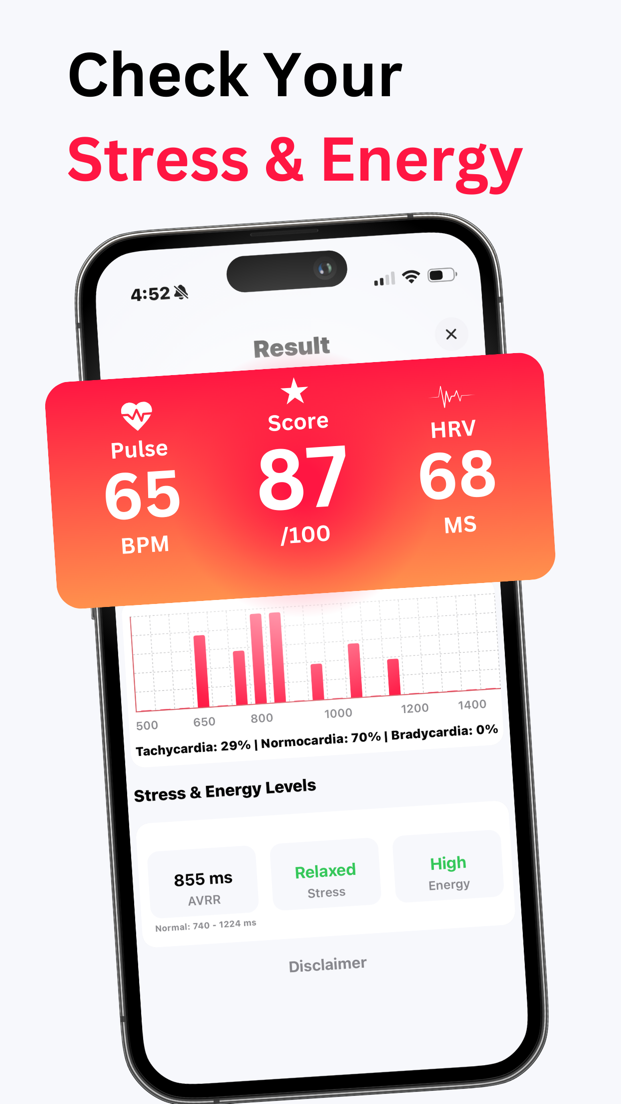
RMSSD, SDNN, pNN50
All the standard time-domain HRV metrics, each explained in a sentence, with the R-R interval histogram behind them.
Your baseline, not a stranger’s
After a week of readings the app knows your normal. Each new reading is compared with your 30-day baseline and with the typical range for your age.
Stress and energy from HRV
Lower variability usually means your stress system is working harder. The app turns that into a readable stress level and energy level.
Why HRV matters
Your heart does not beat like a metronome. The gap between beats changes slightly with every breath and with the balance between your “fight or flight” and “rest and digest” nervous systems. More variation at rest usually means better recovery, better sleep and a well-adapted nervous system. Less variation often follows a short night, alcohol, illness, overtraining or sustained stress.
Because it reacts within hours, HRV is one of the earliest signals that something is off, long before resting heart rate climbs. Track it each morning and you get a daily readiness read-out that is personal to you.

How to get consistent HRV readings
- Measure in the morning before caffeine, seated or lying down.
- Keep your hand and finger still and your breathing natural.
- Use the same finger and the same position every day.
- Look at the 7-day trend rather than any single reading.
HRV FAQ
What is a good HRV?
HRV is highly individual. RMSSD values of 20 to 70 ms are common in healthy adults, and it falls with age. Comparing with your own baseline is far more useful than comparing with other people. See What is HRV? for ranges by age.
How does Pulse Tracker measure HRV?
From the camera pulse wave. The app detects each beat, measures the time between beats (the R-R or inter-beat interval) and computes RMSSD, SDNN, pNN50 and the coefficient of variation over the measurement window.
When should I measure HRV?
First thing in the morning, seated or lying down, before coffee, at the same time every day. Morning readings taken the same way are the most comparable.
Is camera HRV as accurate as a chest strap?
A chest strap ECG remains the gold standard. Fingertip PPG at rest tracks it closely for RMSSD, but is more sensitive to movement. Keep still and use the Measurement Quality score.
Is HRV included in the free version?
HRV analysis, baselines and stress and energy scores are Premium features. Heart rate and respiratory rate are free.
Check your HRV this morning
Download free and take your first reading. Premium unlocks HRV analysis with a 3-day free trial.
Download for iPhoneRequires iOS 17 or later · ★ 4.7 rating · Available in 8 languages
Wellness disclaimer. Pulse Tracker is intended for general wellness use only. It is not a medical device, is not FDA cleared or approved, and is not intended to diagnose, treat, cure or prevent any disease or condition. Blood pressure shown in the app is either a value you entered from your own cuff or an estimate derived from the pulse signal after cuff calibration; it is not a measurement and must not be used to make medical decisions. Read the full wellness disclaimer. Camera readings, estimates and classifications are for general information only and can be affected by movement, lighting, skin temperature and other factors. Do not use them to diagnose, treat or make decisions about a medical condition. Always consult a qualified healthcare professional, and call emergency services if you have chest pain, shortness of breath, fainting or other urgent symptoms.